

You’ve packed up, handed back the keys and flown home, but your super is still sitting in Australia. That’s the awkward part for temporary residents: the money was paid in while you worked, it doesn’t follow you out the door, and a visa that’s still active can block your claim. If you’re working out how to claim superannuation when leaving Australia, the timing of each step matters. Most of the preparation can be done before you leave, and this guide covers who’s eligible, how to find every fund, what the application needs and how much tax comes off before the money reaches you.
Departing Australia superannuation payment eligibility
You can claim a departing Australia superannuation payment (DASP) if you earned super while working here on an eligible temporary visa and you’ve since left. Your employer also has to have paid super contributions during your employment.
Temporary visa
Your work must have been done on a temporary visa. That covers student, working holiday and skilled worker visas, among others. Subclass 405 and 410 visas are the exception, so holders of those can’t claim.
Departure and visa status
Leaving isn’t enough on its own. Your visa has to have expired or been cancelled, and you can’t hold another active Australian visa. The ATO checks your visa status with the Department of Home Affairs automatically, so an application made while your visa is still current can be rejected.
Citizenship status
Australian citizens and permanent residents can’t claim DASP. New Zealand citizens are a special case. Those on a Special Category Visa (subclass 444) usually aren’t eligible, but a New Zealand citizen who held another temporary visa that has since expired may still qualify.
How to claim superannuation when leaving Australia
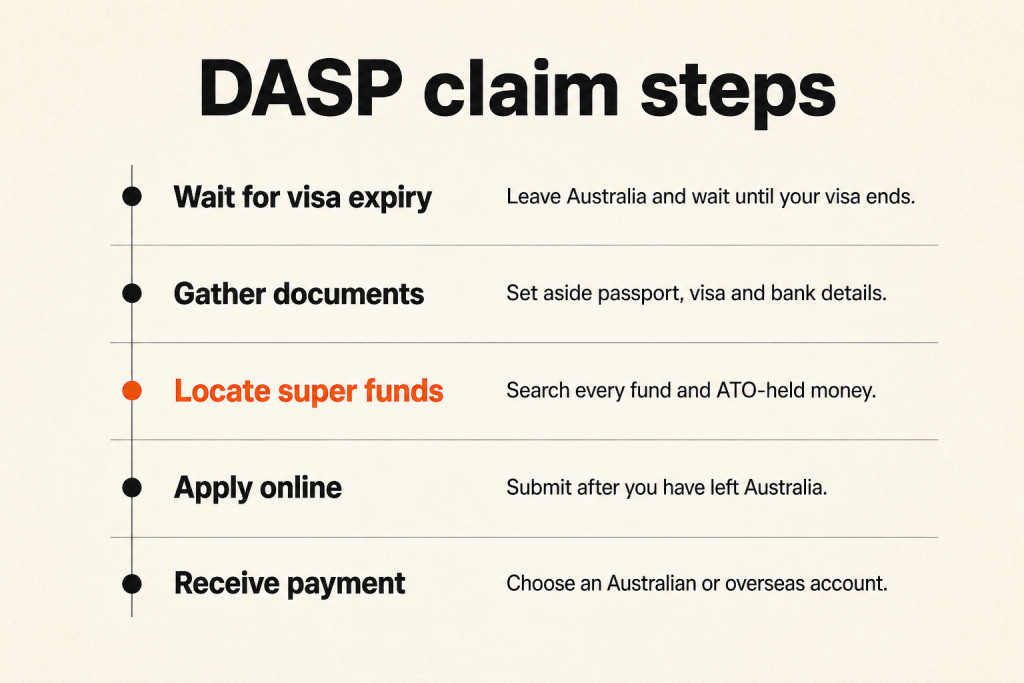
A DASP claim has five stages: wait for your visa to end, gather your documents, find every super fund, apply, and set up payment. Step 1 is the waiting stage. Steps 2 and 3 are easier before you leave, and Steps 4 and 5 come once your visa has ended.
Step 1: Wait until your visa has expired
A claim can’t be submitted while your visa is active, so the first job is waiting. Once you’ve left and your visa has expired or been cancelled, you can apply. Leaving before your visa legally ends doesn’t get around this. The ATO can still reject the application if the visa hasn’t expired, unless you’ve formally asked immigration to cancel it, and that is a visa decision worth checking with Home Affairs first. Use the time before you leave, because most of the preparation is easier to do from Australia.
Step 2: Gather your documents
Collect these before you go:
- Your name, date of birth and email address.
- The country and number of the passport you used in Australia.
- Your visa details, such as the number or a copy of the grant notice.
- Your super account details, including the member number you’ll find by logging in to your online account.
- Your tax file number (TFN), if you know it. It’s optional, but it makes the search for other super accounts quicker.
- Your bank details. For an international transfer that means the overseas bank’s SWIFT/BIC code as well. Keeping an Australian account open is usually the quickest way to be paid, because it avoids international transfer charges and delays.
- A valid overseas address, updated with your super fund before you leave.
Some funds, and paper applications, ask for certified copies of your ID, and certification has its own rules (see the section on delays below). Ask each provider what it wants while you’re still in Australia, because arranging certified copies from overseas is slower.
Step 3: Locate your super funds
If you know which fund received your employer’s payments, you can claim from that fund or apply through the ATO. Money can sit in several funds if you’ve had more than one employer and never checked which fund each one used. Ask each former employer which fund it paid into.
For the funds you can’t name, the ATO’s online service can search for lost super, and a tax agent can run the search for you. Our guide to a lost superannuation search walks through it. Once your identity is confirmed, you can link your myGov account to the ATO and search there. If six months or more have passed since you left and your visa ended, your fund may already have passed your super to the ATO as unclaimed super, and our guide to finding and claiming unclaimed super covers that case.
For help with a DASP claim, you can phone the ATO on 13 10 20 from Australia or +61 2 6216 1111 from overseas, or write to DASPmail@ato.gov.au. Phone lines run Monday to Friday, Australian Eastern time.
Step 4: Apply online through the ATO
After you’ve found your super, submit a DASP application through the ATO’s online tool. The tool covers money held by a super fund and money held by the ATO. A registered tax agent can lodge the claim for you too. That can spare you the forms, but it doesn’t change the rules or the tax.
Applying online costs nothing, while a fund may charge to process a paper claim. If you do go on paper, there’s one form for money still in a fund and a separate one for money the ATO holds. To apply online:
- Go to the Australian Taxation Office (ATO) DASP online application.
- Enter your personal and fund details.
- Submit once you’ve left Australia and your visa has ended.
Step 5: Receive your payment
You can be paid into an Australian account by electronic funds transfer (EFT), or into an overseas account by telegraphic transfer (TT).
Electronic funds transfer (EFT) to an Australian bank account
The payment arrives in AUD, and the transfer needs these details:
- The full account name, which must be in your name.
- The BSB, which is the bank’s branch code and always 6 digits.
- The account number, usually 6 to 10 digits.
Telegraphic transfer (SWIFT) to an international bank account
An international transfer may arrive in AUD or USD, and the bank adds charges for it. The transfer needs these details:
- The overseas bank name and the branch name, if any.
- The overseas bank address, including the country.
- The bank ID, such as the SWIFT/BIC code or your country’s local bank code, and the account number.
- The account name, which must be in your name.
- Your postal address as the overseas bank has it on record.
- The currency, AUD or USD.
Your bank can tell you which identifier applies in your country, such as a SWIFT code, sort code, routing number or IBAN. The ATO currently doesn’t accept Revolut or Wise accounts, so use an ordinary bank account.
DASP tax rates by super component
The tax depends on which part of your super is paid out: nil on the tax-free component, 35% on the taxed element and 45% on the untaxed element of the taxable component. The taxed element is the part your fund has already paid tax on, and the untaxed element is the part it hasn’t. Working holiday makers (WHM), meaning people who held a working holiday visa, pay 65% on both.
| Payment component | DASP ordinary tax rate (for non-WHM) | DASP WHM tax rate |
|---|---|---|
| Tax-free component | nil | nil |
| Taxable component, taxed element | 35% | 65% |
| Taxable component, untaxed element | 45% | 65% |
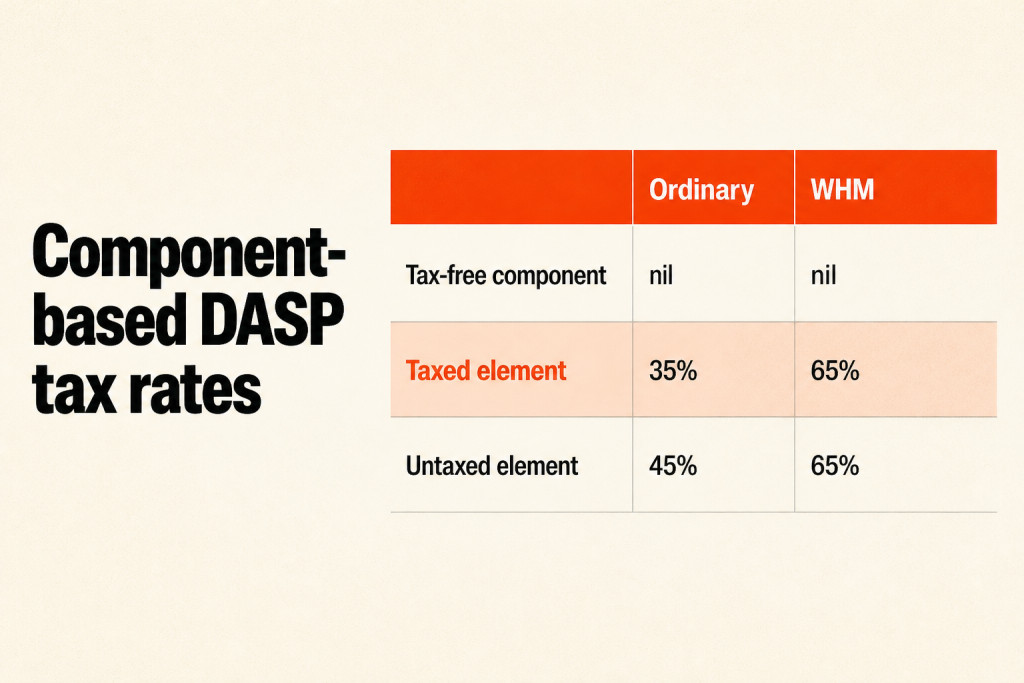
That 65% flat rate cuts a working holiday maker’s payment hard. On the taxed element, an ordinary claimant keeps a little under two-thirds of each dollar and a WHM keeps a little over a third. The ATO withholds the tax when it pays a DASP, and the withholding is final: DASP isn’t assessed in a tax return, so you can’t reclaim it later.
Your fund works out the withheld tax from its own records. Say part of your super was paid in while you held a working holiday visa and the rest while you held a student visa: the fund can then apply more than one rate to the same payout. The fund checks whether each contribution was taxed and which visa conditions were in force when it was made.
Timeframes to claim Australian superannuation
Allow 4 to 8 weeks for a DASP claim, counting from the day you start gathering documents. Only the 28 days for ATO processing is a published service standard. The other stages are estimates, and the total leaves room for slips.
| Stage | Typical Timeframe |
|---|---|
| Document collection and preparation | 1 to 5 days |
| Super fund search and balance verification | 3 to 5 business days |
| Application lodgement | 1 to 2 business days |
| ATO processing | 28 days (service standard) |
| International bank transfer | 2 to 5 business days |
| Total estimated time | 4 to 8 weeks |
Once the ATO has your application, processing generally takes 28 days, and an international transfer adds a few more. Missing or incorrect details can stretch that.
Avoiding DASP claim delays and pitfalls
Most delays come from three slips: missing or inconsistent personal details, a forgotten secret-question answer, and documents certified by someone who isn’t authorised. A fourth risk has nothing to do with delay: who you pay to lodge the claim.
Check your details carefully
Once you submit the application you can’t change it, so review every detail first. Use the same personal details every time you sign in to the ATO DASP portal. When you first apply online you choose a secret question, and you’ll need its answer to get back into the portal later, so write it down somewhere safe.
If you’ve left Australia, only these people can certify your documents
- A Justice of the Peace
- A notary public
- An Australian consular officer or Australian diplomatic officer
- A judge or magistrate of a court
- A registrar or deputy registrar of a court
Offshore operators and fees
Some operators outside Australia charge high fees, and not all of them are registered tax agents. Only a registered tax agent can lodge a DASP for someone else, so check the Tax Practitioners Board register before you hire one. This is general information, and your own visa history and fund details decide your claim.
Frequently asked questions
Can I apply for DASP while still in Australia?
A claim is only possible after you’ve left Australia and any active visa has ended, so the answer is no. The ATO’s advice is to prepare the application while you’re still here.
What happens if I never claim my super?
Unclaimed super stays with the ATO indefinitely, and you can still claim it at any point as a DASP. The guide to finding and claiming unclaimed super explains how to claim money the ATO is holding.
Will claiming DASP affect my ability to return to Australia?
A DASP claim doesn’t stop you coming back to Australia. If you return on another temporary or permanent visa, you can work again, and your next employer will pay super for you into a new fund.
Can New Zealand citizens claim DASP?
Possibly, if they held another temporary visa that has since expired. The Special Category Visa (subclass 444) on its own usually doesn’t count, as the Citizenship status section above explains.
Can my payment be made to an overseas bank account?
You can be paid overseas if you add the overseas bank’s details to your online ATO application. An international transfer brings extra bank charges, and the exchange rate on the day sets the final amount you receive.
Conclusion
Of everything you can do before you leave, the fund search is the one worth starting first, because it tells you which funds to claim from and whether the ATO already holds some of your super. Keep an Australian bank account open, update your overseas address with each fund, and lodge the claim once your visa has ended. Money nobody claims stays with the ATO, and claiming DASP doesn’t stop you returning on a new visa.
Explore More Topics: