
So, what does a personal accountant do? Quite a bit more than preparing your tax return. Across the year, they keep your records in order, plan your tax before decisions are locked in, and tell you when a job belongs with a different professional.
Below you’ll find the core services, how an accountant differs from a tax agent or a financial adviser, how fees are billed and what to check when you choose someone in Newcastle.
What does a personal accountant do year round
Outside tax season, your personal accountant shows you where your money is going. They record your income, expenses, assets and liabilities, and check them, so you can act on what the books show while there’s still time to change it.
How often you meet depends on how much is going on. If you lodge BAS each quarter, those four dates are a natural time for a check-in. A fast-growing business, or a busy stretch before the financial year ends on 30 June, may call for more. There’s no number that suits everyone.
Bring your accountant in before 30 June and they can spot a problem in your structure or records while it’s still fixable. After the year closes, the options narrow.

Core services for individuals and investors
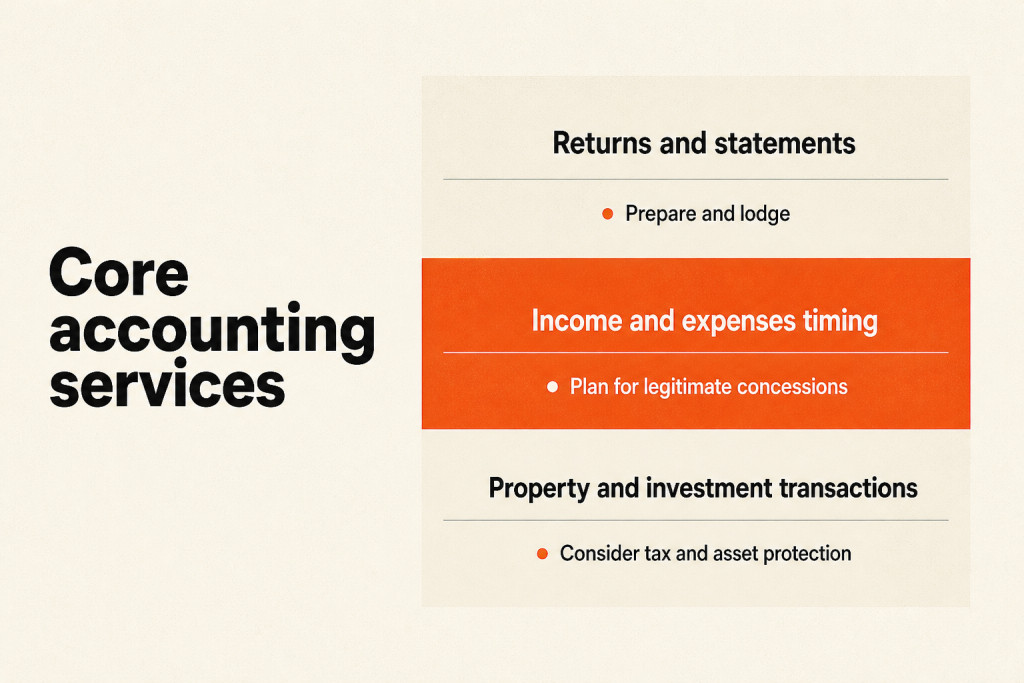
The work falls into three groups, which the sections below take in turn.
Tax return preparation and lodgement
Your accountant keeps your ATO obligations on schedule, starting with your income tax return. If you run a business, that also covers Business Activity Statements (BAS), which report your Goods and Services Tax (GST) and Pay As You Go (PAYG) withholding. If you employ staff, it covers the super you owe them as well. They also check which deductions you’re entitled to and claim those that apply.
If you use a registered tax agent, you may get more time to lodge. Agents can often lodge their clients’ returns after the standard 31 October due date, but only if you’re on the agent’s client list by then. Check the dates that apply to you with your agent, because they depend on your circumstances (an overdue return from an earlier year can remove the extension).
Clear records, and claims you can back with documents, put you in a far better position if the ATO ever asks questions. Keep records through the whole financial year, from July to June, and tax time brings fewer surprises.
Proactive tax planning
Tax planning works on things that haven’t happened yet, because once a transaction is done, or the income year ends on 30 June, the tax treatment is largely set and lodging your return only reports it. So the useful questions are about your business structure, the timing of income and expenses, and which concessions you can legitimately use to reduce your tax bill.
Say you’re thinking of selling shares that have gained in value. The timing of the sale decides which income year the gain falls into. The date that counts is usually the day you sign the contract, so a June contract lands in this income year and a July contract lands in the next. Which suits you depends on your other income, and that’s a conversation for before the sale, not after.
Tax Considerations When Buying Assets
Who buys an asset matters. The buyer, whether that’s you personally, a company or a trust, can affect the tax outcome for capital gains tax (CGT) and GST, and land tax can be affected too. How much depends on the asset, the entity and the state, so ask before you sign a contract.
Here’s a made-up example. Say Dana is about to buy an investment property. If she buys in her own name and later wants it held in a trust, moving it is a separate transaction that can carry its own tax consequences. It’s easier to settle who the owner is before the purchase than to change it afterwards.
Vehicles raise a similar question. The structure you buy a vehicle under can change the fringe benefits tax (FBT) and depreciation outcome, so settle it before you sign.
Personal accountant versus tax agent and financial adviser
Which professional you need depends on the job, and the titles overlap more than you’d expect. A tax agent lodges your return from figures you already have. An accountant plans ahead and gives you a clear view of your records. A licensed financial adviser recommends where to invest. In practice one person often holds more than one of these roles. The guide to what does an accountant do compares these roles in more detail.
Tax agent
A registered tax agent is authorised by the Tax Practitioners Board (TPB) to lodge tax returns on your behalf. They must meet ongoing education requirements and follow a code of conduct, which is why it’s worth checking the registration before you hire anyone to lodge for you. You can search the TPB’s public register at tpb.gov.au.
Accountant
An accountant starts where the bookkeeper stops: they take the finished records, make sense of them, and turn them into financial reports and advice you can act on. Many accountants are also registered tax agents, so both roles may sit with one person, but confirm it rather than assume it.
Licensed financial adviser
If you want a recommendation on a specific investment product, such as which fund to buy, that’s a licensed financial adviser’s job. An accountant can explain the tax side of a decision, but can’t make that recommendation unless they hold the licence too.
Bookkeeper
A bookkeeper records your day-to-day financial transactions. That record is the raw material an accountant works from, so tidy books make the accountant’s job quicker, and the work costs you less if you’re billed by the hour.
Client situations that justify professional accounting
An accountant earns their fee when something changes and your current habits stop being enough.
Starting a business is the clearest case, because your structure, GST registration and record-keeping all need deciding at once. Outgrowing your own bookkeeping is another: if records are eating your evenings, or you’re no longer sure the numbers are right, it’s time. So is a tax situation that has become complex, or a plan to grow, where the question is whether you can afford it.

Your first hire brings payroll, superannuation and PAYG withholding. An accountant can set those up with you before the first pay run, so you’re compliant from day one.
Borrowing for a business or an investment property raises the stakes. A lender will want documents, and you’ll want to know which repayments your cash flow can carry; an accountant can help with both.
Accounting fees and billing arrangements
Accountants usually bill in one of two ways: by the hour, or at a fixed price for a defined job such as an annual tax return or monthly bookkeeping. The pricing model you pick decides what your fee covers.
A fixed fee keeps routine compliance costs predictable, but it buys only the work agreed, and a restructure or an unexpected problem usually falls outside it. Hourly billing suits open-ended advice, because you pay for what the problem turns out to need. The catch is that you won’t know the total until the work is finished.
Whichever you choose, get a written breakdown of what’s included and what isn’t. Compare quotes on scope as well as price, because a low fee for a narrow job can cost more than it looks. The tax-related part of the fee is often deductible, and the FAQ below explains how.
Selecting a certified professional in Newcastle
Start with qualifications and professional membership, then look at local knowledge and industry experience. Fees are only part of the choice.

A CPA, CA or IPA designation tells you the accountant has done recognised study, passed professional exams and committed to ongoing professional development. They come from the three main accounting bodies in Australia: CPA Australia, Chartered Accountants Australia and New Zealand (CA ANZ) and the Institute of Public Accountants (IPA). Check membership with the body itself.
Referrals help you build a shortlist before you check credentials. Other small business owners, people in your network and your bookkeeper can tell you what an accountant is like to work with. The professional bodies’ directories are another route, since CPA Australia, CA ANZ and the IPA each let you search for qualified accountants in your area.
A local accountant who understands NSW rules can be a sensible choice, because some taxes and regulations are set by each state, land tax being one. When you compare tax accountants newcastle, check their credentials and ask about their local knowledge. If you operate across state lines, ask which differences apply to you.
An accountant who already works in your industry will know its usual compliance traps and its opportunities. Ask who else they act for in your sector.
If an accountant will lodge your return, confirm they’re registered with the TPB. Then take a few questions to a first meeting. Ask which qualifications and registrations they hold, whether they have experience in your industry and which accounting software they use. Ask how they communicate with clients and how often, and how they structure their fees.
Frequently asked questions
What is the difference between an accountant and a tax agent?
An accountant helps you make sound financial decisions and stay compliant, while a registered tax agent is authorised to lodge tax returns for clients. If you want someone to lodge yours, use a registered tax agent. Many accountants are registered, so ask.
When should an individual hire a personal accountant?
Hire one when you start a business or get ready to grow. Individuals with an investment property, shares or several income sources may benefit too. When you launch, ask for help choosing a structure (sole trader, partnership, company or trust), registering for GST and setting up your financial systems from day one. Before you expand, ask for projections that show whether you can afford it, and go through the figures together so you can change course before you’ve committed.
How often should clients meet with their accountant?
There’s no set schedule. Business owners often check in around each quarterly BAS date, and individuals often once a year before 30 June. The right rhythm depends on how complex your finances are, so ask your accountant what they’d suggest.
What documents should be prepared before a meeting?
Take your financial records, receipts and any business documents that bear on the question. Come ready to talk about your goals, your problems and any plans that could change your finances, so the time goes on advice instead of hunting for paperwork.
Can personal accounting fees be claimed on tax?
Often, yes, for the tax-related part of the fee. The ATO allows a deduction for the cost of managing your own tax affairs, which includes lodging your return through a registered tax agent and getting tax advice from a recognised tax adviser. Interest charges are different. The general interest charge (GIC) and shortfall interest charge (SIC) are what the ATO adds to late or underpaid tax, and any you incur on or after 1 July 2025 can’t be deducted. Other fees on your bill may be treated differently, so ask your accountant how each part applies to you.
Conclusion
A personal accountant earns the most when you call before a financial choice is fixed, whether that’s choosing a business structure at launch or checking that growth is affordable. Tax time is only part of the job.
Before you pay anyone to lodge a return, check their registration with the Tax Practitioners Board. For the meeting itself, bring your records, receipts and plans. This guide is general information, not advice on your own situation.
Explore More Topics: