
The short answer to “when should you hire a tax accountant” is this: once the fee costs you less than the hours you’d spend and the mistakes you’d risk making. For a small business owner that point usually arrives sooner than expected, because the time you spend on your own return rarely gets priced.
Below, you’ll find the situations that tip the balance, how deadlines and fees come into it, and what to check when you choose someone in Newcastle.

When should you hire a tax accountant instead of DIY?
Start with the arithmetic. Say you’d spend 10 hours on your return and your time is worth $100 an hour. That’s $1,000 of your time, and those hours could earn revenue for your business instead. Set that against the accountant’s quote. If the fee is lower, hiring is the cheaper option.
Mistakes cost money too. The ATO’s 2022–23 estimate puts more than $5 billion of the small business income tax gap down to honest mistakes, poor record-keeping and confusion over obligations. A good accountant can also spot deductions you would have overlooked.
Late lodgement is common too. In a 2023 speech, an ATO Deputy Commissioner said about 70% of activity statements were lodged on time, while almost 90% of tax liabilities were paid on time.
If you’ve ever typed “do i need an accountant for tax return” into a search box, this is the trade-off you were really asking about. On one side is the risk of lodging your own return. On the other is the peace of mind of having a specialist handle the details. A few signs show your tax affairs are getting too much to handle alone. You’re falling behind on BAS or tax lodgements, cash flow is tight, unexpected tax bills keep turning up, or your record-keeping has slipped.
Complex assets and income streams
If your income is only standard payroll summaries and tax has already been withheld, DIY tools can usually do the job. The trouble starts when you add investment income, depreciation deductions or an asset that exposes you to foreign currency, such as overseas shares or property. At that point, errors in self-lodgement can multiply.
In practice, four situations cause most of the trouble.
The first is multiple income sources: a salary plus freelance work plus a rental makes for a much harder return than any one of them alone.
The second is an investment portfolio. Shares, property, crypto and managed funds all have their own capital gains, dividend and franking credit rules. Mixing them is where people slip.
The third is overseas income, because anything earned or held abroad adds reporting rules and the chance of being taxed twice.
The fourth is a change of business structure. Moving from sole trader to a company or trust triggers one-off tax events, and it’s easy to slip on those.
Here’s a made-up example. Say Priya is an employee who also rents out a unit and runs a small business on the side. Each income stream is simple on its own. Put them together and she needs separate records for each, deductions kept apart, and, once the business’s turnover reaches $75,000, a GST registration and BAS lodgements. That threshold is turnover, not profit.
Confident DIY filers still trip over the same four things.
They leave out taxable income. Cash payments, foreign income, crypto gains and side-hustle earnings are all taxable, and leaving any of them off can trigger an ATO audit.
They overclaim deductions. You should only claim what directly relates to earning your income, because the ATO compares claims against industry averages and inflated deductions tend to stand out.
Pre-filled ATO data is another trap. The myTax pre-fill is a useful start, but it can miss details. Interest income, dividends and private health insurance details may be missing or delayed.
The last is poor record-keeping. If you can’t produce a receipt for a deduction, the ATO can disallow it entirely during a review.
Starting a business or switching from sole trader to company structure
Starting a business, or switching from a sole trader to a company, is a good moment to bring in an accountant, because your structure changes your tax, your liability and how easily you can grow. It pays to get advice first. A sole trader is simple to set up, and the business income and expenses go on your own tax return. The catch is that you’re personally liable for all business debts.
A company limits your personal liability to the assets the business owns. It’s more complex to manage, but it offers greater protection.
In a partnership, the partners share responsibilities and profits, and each partner is liable for business debts.
Tax office audit notices or overdue lodgements
Not every ATO notice needs an accountant. One that involves an audit, a complex issue or a deadline you may struggle to meet does, and the sooner the better. An accountant can guide you through the process and help prevent future compliance issues. If you don’t have one already, hire one promptly, and ideally before an audit starts. Look for a practice that offers audit insurance, which covers professional costs arising from contact with the tax office, including questions, reviews and audits. Without it, you’ll pay extra for the considerable work an audit requires.
Critical lodgement deadlines
Engage a registered tax agent before the 31 October self-lodgement date if you want more time to lodge. Registered tax agents may lodge under an extension, which for the 2025–26 individual return runs to 15 May 2027. The table sets out the dates.

| Lodgement type | Standard deadline | Tax agent extension | What to watch |
|---|---|---|---|
| Individual lodging for yourself | 31 October 2026 | Not applicable | Late lodgement attracts penalties that increase over time. |
| Individual using a registered tax agent | 31 October 2026 (the self-lodgement date) | 15 May 2027. You can lodge as late as 5 June 2027 without penalty if you qualify and any payment is also made by then | Be on the agent’s client list by 31 October 2026. |
| Individual or trust with an overdue prior-year return at 30 June 2026 | 31 October 2026 | None: 31 October 2026 applies even with an agent | Lodge every overdue return by 31 October 2026 to return to the normal agent program. |
The other date to plan around is 30 June. A review before then can save far more than it costs, because the choices available after year-end are limited. A good pre-30 June review covers year-end and tax planning for profit, super, depreciation, dividends or trust distributions. It also covers help with capital gains tax (CGT) events, small business concessions or Division 7A. At a minimum, put quarterly BAS and reviews in the diary.
Which Financial Professional Do You Need?
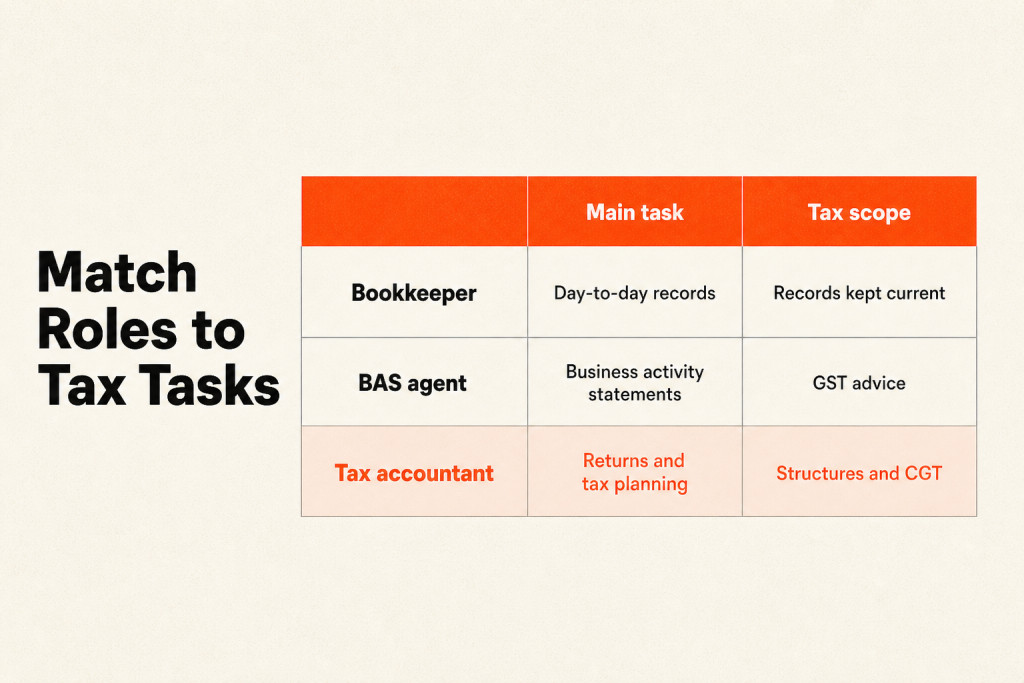
Bookkeepers keep your day-to-day records, BAS agents lodge your activity statements, and registered tax accountants handle year-end returns, capital gains planning and dealing with the ATO for you. The roles overlap, so match the role to the task.
Bookkeepers
A bookkeeper records your day-to-day transactions, reconciles bank statements against your account records and produces basic reports. They can also code transactions and manage receipts, so your file is clean and ready for BAS and tax. An accountant steps up to tax planning, financial analysis, business advisory and statutory accounts.
BAS agents
A registered BAS agent lodges BAS and IAS and advises on GST, PAYG and fuel tax credits. They can also help you register for GST, correct GST matters and deal with ATO queries.
Tax accountants
A tax accountant handles year-end accounts, tax returns, tax planning, structures, Division 7A and CGT. You need one at EOFY (the end of the financial year, 30 June) and for anything complex.
One rule applies to all of them. Anyone who lodges tax returns or gives tax advice for payment must be registered with the Tax Practitioners Board as a registered tax agent. Check the registration before you pay. An accountant may hold CPA, CA or IPA qualifications, but those qualifications alone don’t allow paid tax services.
Expected accounting costs
What an accountant charges depends on the work, so one figure wouldn’t tell you much. A straightforward individual return costs less than a sole trader return with business income, GST and activity statements. Monthly accounting for a small business, covering bookkeeping, BAS lodgement, payroll and reporting, is priced differently again. Advisory work such as tax planning and structuring is a separate job. Ask for a quote in writing that lists what’s included before you agree to anything.
You pay the fee up front, and you can generally deduct it on a later tax return, which takes the edge off the cost. Lodging late costs money too. The Australian Taxation Office says it can attract one penalty unit for each 28 days, or part of 28 days, that it stays overdue, up to a maximum of five penalty units. Weigh the fee against that, and against the cost of getting a return wrong, and you have the usual answer to “why hire a tax accountant”.
You can claim what it costs to manage your own tax affairs, including preparing and lodging returns and activity statements. That covers lodging your return through a registered tax agent and getting tax advice from a recognised tax advisor. Dealing with the ATO about your tax affairs counts too.
Interest charges follow their own rule. The general interest charge (GIC) and shortfall interest charge (SIC) you incur on or after 1 July 2025 can’t be deducted.
If one invoice covers your tax return and returns for associated people, such as your spouse, split the fee between you. You’ll need to show how you worked out each person’s share, and keep records as evidence for the deduction. Fees are generally incurred in the income year you pay them.
Choosing an accountant in Newcastle
When you compare local options such as tax accountants newcastle, start with registration. Anyone who gives income tax advice or files returns for you needs active registration with the Tax Practitioners Board. Tax work can’t be done without it.

Qualifications come next. Check an accountant’s education, experience and ethics, because they show which standards the person has met to protect you. CPA Australia, Chartered Accountants Australia and New Zealand and the Institute of Public Accountants are the memberships to look for.
Advice fits better when the accountant knows your industry, so ask whether they serve businesses like yours. Three things matter.
Industry comes first, because retail, construction, professional services and hospitality each have their own accounting needs.
Size matters too: an accountant used to large corporations may not suit a sole trader.
And stage counts, since startups, growing businesses and established companies face different challenges.
Then get a clear breakdown of what’s covered at each service level before you agree to work together.
A tax-returns-only service is basic compliance work at tax time.
Ongoing bookkeeping means regular transaction recording and reconciliation.
Advisory gives you strategic advice on growth, cash flow and business decisions.
Payroll and BAS (Business Activity Statement) covers employee payments and GST (Goods and Services Tax) obligations.
Working on one accounting software platform makes it easier to work together, so ask which system your accountant uses and recommends. Cloud-based software lets you both see the same data in real time. It also puts your records in someone else’s hands, so ask how the practice keeps them safe.
Do they use encrypted file sharing and secure cloud storage instead of email attachments?
Who in the practice can access your financial records, and how are permissions managed?
Can their systems protect your data from loss, ransomware or hardware failure?
And do they follow the Australian Privacy Principles and have a clear privacy policy for client data?
Last, pin down the work before you commit. If you need advisory as well as compliance, check whether the service includes planning, cash flow and dashboards alongside BAS and tax. Ask what service looks like during busy periods, who you’ll deal with day to day, and how urgent issues are escalated. Fees may be fixed or hourly, so check exactly what each package includes. Confirm that advisory help is available when a decision can’t wait.
Frequently asked questions
What’s the difference between a registered tax agent and an accountant?
Only a registered tax agent can legally charge for tax services. An accountant with CPA, CA or IPA qualifications still needs to be registered as a tax agent before you hire them for tax work.
Can an accountant help extend my tax deadline?
Often, yes, provided you engage a registered tax agent before your original due date and ask which extension applies to you. Don’t assume it’s automatic, because the conditions matter.
What records should I keep for my accountant?
Keep every business-expense receipt, plus bank and credit card statements, invoices, payroll records, contracts and loan agreements. The ATO says you need to keep most business records for five years.
Is hiring an accountant worth the cost?
Usually, once your return is more than simple payroll income. An accountant saves time and helps prevent errors, and the deductions and tax savings they identify may be worth more than their fees.
How do I know if an accountant is qualified in Australia?
Look for membership of CPA Australia, Chartered Accountants Australia and New Zealand or the Institute of Public Accountants. For tax services, also check registration with the Tax Practitioners Board at tpb.gov.au.
Conclusion
Hire a tax accountant when the fee is smaller than the value of the hours and the risk it takes off you. If your income is simple payroll and tax has already been withheld, DIY tools are usually enough. Add investments, a rental, overseas income or a new business structure, and the case flips quickly.
Whichever way you go, check the practitioner’s registration with the Tax Practitioners Board before you pay anyone for tax work, and ask for a quote in writing that says what’s included. This guide is general information, not advice on your own situation.
Explore More Topics: